Sindbad PUZZLE

Retrouvez des chefs-d'oeuvre de la miniature persane et indienne en PUZZLES sur le site : http://www.sindbad-puzzle.com/

Affichage des articles dont le libellé est Robert Frost. Afficher tous les articles

jeudi 17 février 2011

Robert Frost : Birches

Winter Afternoon, Willard Leroy Metcalf

Birches, l’un des touts premiers poèmes de Robert Frost. Il lui a amené le succès et fait connaître du grand public. Tous les thèmes principaux de l’œuvre à venir sont déjà présents dans ce poème : l’évocation puissante de la nature, les conflits intérieurs entre l’envie d’évasion et les responsabilités à assumer, le paradis perdu de l’enfance, l’aspiration à s’élever vers le ciel et l’attirance irrésistible vers la terre, le va-et-vient entre rêve et réalité…

Birches

When I see birches bend to left and right
Across the lines of straighter darker trees,
I like to think some boy's been swinging them.
But swinging doesn't bend them down to stay.
Ice-storms do that. Often you must have seen them
Loaded with ice a sunny winter morning
After a rain. They click upon themselves
As the breeze rises, and turn many-coloured
As the stir cracks and crazes their enamel.
Soon the sun's warmth makes them shed crystal shells
Shattering and avalanching on the snow-crust
Such heaps of broken glass to sweep away
You'd think the inner dome of heaven had fallen.
They are dragged to the withered bracken by the load,
And they seem not to break; though once they are bowed
So low for long, they never right themselves:
You may see their trunks arching in the woods
Years afterwards, trailing their leaves on the ground,
Like girls on hands and knees that throw their hair
Before them over their heads to dry in the sun.
But I was going to say when Truth broke in
With all her matter-of-fact about the ice-storm,
I should prefer to have some boy bend them
As he went out and in to fetch the cows--
Some boy too far from town to learn baseball,
Whose only play was what he found himself,
Summer or winter, and could play alone.
One by one he subdued his father's trees
By riding them down over and over again
Until he took the stiffness out of them,
And not one but hung limp, not one was left
For him to conquer. He learned all there was
To learn about not launching out too soon
And so not carrying the tree away
Clear to the ground. He always kept his poise
To the top branches, climbing carefully
With the same pains you use to fill a cup
Up to the brim, and even above the brim.
Then he flung outward, feet first, with a swish,
Kicking his way down through the air to the ground.
So was I once myself a swinger of birches.
And so I dream of going back to be.
It's when I'm weary of considerations,
And life is too much like a pathless wood
Where your face burns and tickles with the cobwebs
Broken across it, and one eye is weeping
From a twig's having lashed across it open.
I'd like to get away from earth awhile
And then come back to it and begin over.
May no fate willfully misunderstand me
And half grant what I wish and snatch me away
Not to return. Earth's the right place for love:
I don't know where it's likely to go better.
I'd like to go by climbing a birch tree
And climb black branches up a snow-white trunk
Toward heaven, till the tree could bear no more,
But dipped its top and set me down again.
That would be good both going and coming back.
One could do worse than be a swinger of birches.

Robert Frost

jeudi 10 février 2011

Robert Frost : Bereft

John Francis Murphy

Bereft, encore un poème de Robert Frost évoquant d'une manière poignante le sentiment de solitude, d'abandon et de désespoir. La nature dans ce poème devient hostile et menaçante. Le vent rugit comme une bête féroce et le tourbillon de feuilles soulevées par le vent prend la forme d'un serpent qui lance une attaque mortelle contre le poète.

BEREFT

Where had I heard this wind before
Change like this to a deeper roar?
What would it take my standing there for,
Holding open a restive door,
Looking down hill to a frothy shore?
Summer was past and the day was past.
Sombre clouds in the west were massed.
Out on the porch's sagging floor,
Leaves got up in a coil and hissed,
Blindly striking at my knee and missed.
Something sinister in the tone
Told me my secret must be known:
Word I was in the house alone
Somehow must have gotten abroad,
Word I was in my life alone,
Word I had no one left but God.

Essai de traduction :

DÉPOUILLÉ

Où ai-je donc entendu un vent pareil auparavant
Se changer ainsi en un rugissement féroce ?
Que va-t-il penser de moi me tenant debout,
Gardant cette porte qui claque ouverte,
Regardant la berge écumeuse au pied de la colline ?
L’été s'en est allé et le jour s'en est allé
Des nuages sombres se sont amoncelés à l’ouest.
Devant l’entrée de la maison sur la marche
Un tourbillon de feuilles s’est levé en sifflant
Pour lancer contre mes jambes
Une attaque aveugle manquée de justesse.
Quelque chose de sinistre dans le ton
Me susurrait que mon secret devait être révélé
Et trouver sa voie vers la sortie :
Que dans la maison je suis seul
Que dans ma vie je suis seul,
Je n’ai à mes côtés d’autre que Dieu.

Robert Frost

Robert Frost : Mending Wall

Allen Butler Talcot

Mending Wall est l’un des poèmes les plus populaires et appréciés de Robert Frost. Il est surtout célèbre pour le fameux vers : « Good fences make good neighbors » (« Les bonnes clôtures font les bons voisins »). On doit à Frost d’avoir remis au goût du jour cet adage ancien qui était tombé dans l’oubli.
Comme tant d’autres poèmes de Frost, celui-ci a donné lieu à de nombreuses interprétations, tant sociales que politiques. Il paraîtrait que Frost, en entendant ces interprétations, fronçait les sourcils et déclarait que le poème ne signifie pas plus que ce qu’il veut dire.
Mending Wall nous montre deux voisins qui, le printemps venu, restaurent comme chaque année après les dégâts de l'hiver, le muret de pierre qui sépare leurs champs. L’un deux s’interroge et demande à l’autre l’utilité d’une telle restauration vu qu’ils n’ont pas de bêtes en pâturage sur leurs terres ni les mêmes plantations d’arbres. A toutes ces objections, l’autre se contente de répondre par la sagesse ancestrale : « Les bonnes clôtures font les bons voisins ».
On remarquera en lisant ce poème le sens de l'observation de Robert Frost, sa capacité à animer, à croquer et à faire parler les ruraux avec beaucoup de justesse. Mending Wall fait partie de ces poèmes qui sont des tranches de vie et constituent de véritables scènes de la vie rurale. Pas étonnant que Frost fut considéré aux Etats-Unis comme le barde national, l'ami du peuple, le sage que l'on consultait pour un avis ou un jugement.

Mending Wall

Something there is that doesn't love a wall,
That sends the frozen-ground-swell under it,
And spills the upper boulders in the sun,
And makes gaps even two can pass abreast.
The work of hunters is another thing:
I have come after them and made repair
Where they have left not one stone on a stone,
But they would have the rabbit out of hiding,
To please the yelping dogs. The gaps I mean,
No one has seen them made or heard them made,
But at spring mending-time we find them there.
I let my neighbor know beyond the hill;
And on a day we meet to walk the line
And set the wall between us once again.
We keep the wall between us as we go.
To each the boulders that have fallen to each.
And some are loaves and some so nearly balls
We have to use a spell to make them balance:
'Stay where you are until our backs are turned!'
We wear our fingers rough with handling them.
Oh, just another kind of out-door game,
One on a side. It comes to little more:
There where it is we do not need the wall:
He is all pine and I am apple orchard.
My apple trees will never get across
And eat the cones under his pines, I tell him.
He only says, 'Good fences make good neighbors'.
Spring is the mischief in me, and I wonder
If I could put a notion in his head:
'Why do they make good neighbors? Isn't it
Where there are cows?
But here there are no cows.
Before I built a wall I'd ask to know
What I was walling in or walling out,
And to whom I was like to give offence.
Something there is that doesn't love a wall,
That wants it down.' I could say 'Elves' to him,
But it's not elves exactly, and I'd rather
He said it for himself. I see him there
Bringing a stone grasped firmly by the top
In each hand, like an old-stone savage armed.
He moves in darkness as it seems to me-
Not of woods only and the shade of trees.
He will not go behind his father's saying,
And he likes having thought of it so well
He says again, "Good fences make good neighbors."

Robert Frost

mercredi 9 février 2011

Robert Frost : Good Hours

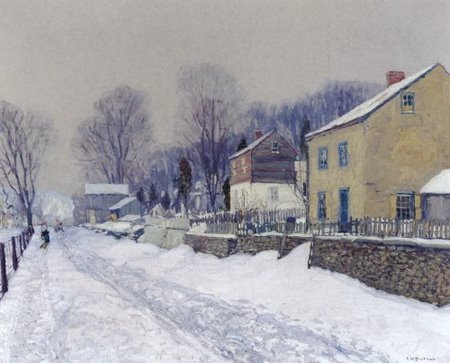
The Village of Center Bridge, Edward Willis Redfield

Good Hours de Robert Frost est un poème pudique et sensible sur la solitude et la vieillesse.

GOOD HOURS

I had for my winter evening walk-
No one at all with whom to talk,
But I had the cottages in a row
Up to their shining eyes in snow.

And I thought I had the folk within:
I had the sound of a violin;
I had a glimpse through curtain laces
Of youthful forms and youthful faces.

I had such company outward bound.
I went till there were no cottages found.
I turned and repented, but coming back
I saw no window but that was black.

Over the snow my creaking feet
Disturbed the slumbering village street
Like profanation, by your leave,
At ten o'clock of a winter eve.

Essai de traduction :

L'heure idéale

J’ai été faire ma marche quotidienne des soirs d’hiver -
Je n’avais personne à mes côtés à qui parler,
Mais j’avais les pavillons alignés en rang
Avec leurs yeux brillants dans la neige.

Et je me suis senti en compagnie des gens vivant dedans :
J’entendais le son d’un violon ;
J’apercevais à travers des rideaux en dentelles
Des jeunes gens aux visages agréables.

Leur compagnie me suivit jusqu’à l’extérieur du village.
Je continuai jusqu’à ne plus avoir un seul pavillon.
Je tournai alors les talons en me repentant, mais sur le retour
Je ne vis que des fenêtres obscures.

Sous mes pieds la neige craquait
Et dérangeait le village endormi
Comme une profanation, causée par un départ impromptu
A dix heures du soir une nuit d’hiver.

Robert Frost

lundi 7 février 2011

Robert Frost : The Pasture

George Innes

Délicate petite perle que ce poème évoquant le renouveau dans un cadre champêtre. L'invitation faite au lecteur par le poète à l'accompagner aux pâturages donne un charme tout particulier à ce poème.

THE PASTURE

I'm going out to clean the pasture spring;
I'll only stop to rake the leaves away
(And wait to watch the water clear, I may):
I shan't be gone long. - You come too.

I'm going out to fetch the little calf
That's standing by the mother. It's so young,
It totters when she licks it with her tongue.
I shan't be gone long. - You come too.

Essai de traduction :

Aux pâturages

Je sors nettoyer la source dans le pré ;
Je ne m’arrêterai que le temps de la débarrasser des feuilles
(Et aussi pour voir l'eau pure couler, oui peut-être) :
Je ne serai pas parti longtemps. – Tu viens aussi.

Je sors nourrir le petit veau
Qui se tient près de sa mère. Il est si jeune,
Il trébuche quand elle le lèche avec sa langue.
Je ne serai pas parti longtemps. – Tu viens aussi.

Robert Frost

Robert Frost : Come in

Deep forest in fall, John Joseph Enneking

"Come in" est un poème de Robert Frost particulièrement apprécié du grand public et a donné lieu à de nombreuses interprétations, parfois totalement opposées. A sa parution, il fut essentiellement considéré comme un poème bucolique et optimiste, chantant la nature et la liberté. Lors de la seconde guerre mondiale, il fut largement distribué aux soldats américains afin de relever le moral et l'optimisme des troupes.
Le poète russe, Joseph Brodsky, Prix Nobel de Littérature, vit dans ce poème le reflet de l'âme torturée de son auteur. Brodsky, reprenant la formule d'un critique littéraire, considérait Frost comme un poète "terrifiant". Pour Brodsky, "Come in" est un poème allégorique évoquant les penchants morbides et suicidaires du poète. Ces penchants sont signifiés par le chant mélodieux de la grive qui, caché dans les ténèbres de la forêt, incite le poète, parvenu à la lisière de la forêt, à revenir sur ses pas ("Thrush music went almost like a call to come in to the dark"). Finalement, le poète résistant à l'attrait de ses pulsions morbides choisit de poursuivre sa route vers la lumière et la vie ("But no, I was out for the stars").

COME IN

As I came to the edge of the woods,
Thrush music - hark!
Now if it was dusk outside,
Inside it was dark.

Too dark in the woods for a bird
By sleight of wing
To better its perch for the night,
Though it still could sing.

The last of the light of the sun
That had died in the west
Still lived for one song more
In a thrush's breast.

Far in the pillared dark
Thrush music went -
Almost like a call to come in
To the dark and lament.

But no, I was out for stars;
I would not come in.
I meant not even if asked;
And I hadn't been.


Robert Frost

dimanche 6 février 2011

Robert Frost l'Obscur

Robert Frost

Robert Frost est surtout connu comme le chantre des paysages magnifiques de la Nouvelle-Angleterre et de la vie rustique. Cet aspect bucolique de son œuvre tend parfois à éclipser des poèmes au caractère plus personnel et qui dans leur contenu sont souvent particulièrement sombres, pessimistes et désespérés. La vie de Robert Frost fut marquée par une longue suite de tragédies : décès prématurés de plusieurs membres de sa famille : son père, sa mère, sa femme, plusieurs de ses enfants dont son fils Carol qui se suicida en se tirant une balle d'un fusil de chasse. Le poète et sa femme furent sujets à des phases de dépressions récurrentes et la maladie frappa également durement la famille Frost : aliénation mentale, cancer... Deux poèmes, très forts, se font l'écho des souffrances endurées par le poète et témoignent du regard pessimiste et désespéré qu'il pouvait porter à l'occasion sur la vie. Le premier, "Nothing Gold can Stay", illustre la vision résignée du poète sur le devenir inéluctablement tragique des choses : la lumière finit immanquablement par s'éteindre et le paradis de se transformer en enfer. Son commentateur, Louis Untermeyer déclare que rarement tant de choses ont été dites en si peu de mots. Dans "Acquainted with the Night", le poète évoque de manière bouleversante le sentiment de solitude qui s'est emparé de son coeur : personne pour le secourir dans la nuit, dans l'immensité de la ville, nulle lueur d'espoir pour le retenir et le ramener vers la vie. Le poète n'a d'autre choix que de s'enfoncer plus en avant dans l'obscurité.

Sycomore in Autunm, Edgar Payne

NOTHING GOLD CAN STAY

Nature's first green is gold,
Her hardest hue to hold.
Her early leaf's a flower;
But only so an hour.
Then leaf subsides to leaf.
So Eden sank to grief,
So dawn goes down to day.
Nothing gold can stay.


Edward Hopper, Night Shadows

ACQUAINTED WITH THE NIGHT

I have been one acquainted with the night.
I have walked out in rain -- and back in rain.
I have outwalked the furthest city light.

I have looked down the saddest city lane.
I have passed by the watchman on his beat
And dropped my eyes, unwilling to explain.

I have stood still and stopped the sound of feet
When far away an interrupted cry
Came over houses from another street,

But not to call me back or say good-bye;
And further still at an unearthly height,
A luminary clock against the sky

Proclaimed the time was neither wrong nor right.
I have been one acquainted with the night.

Robert Frost

vendredi 4 février 2011

Robert Frost : Fire and Ice

Death, Oscar Bluemner
Fire and Ice

Some say the world will end in fire,
Some say in ice.
From what I've tasted of desire
I hold with those who favor fire.
But if I had to perish twice,
I think I know enough of hate
To say that for destruction ice
Is also great
And would suffice.

Essai de traduction :

Feu et Glace

Certains disent que le monde finira dans le feu,
D'autres disent dans la glace.
Pour ce que j’ai goûté de désirs
Je rejoins ceux qui penchent pour le feu.
Mais si je devais périr deux fois,
Je crois que je connais suffisamment la haine
Pour dire que pour la destruction la glace
Est tout aussi formidable
Et saurait amplement suffire.

Robert Frost's Poems, St. Martin's Paperbacks

jeudi 3 février 2011

Frost : Stopping by Woods on a Snowy Evening

Winter harmony, John Henry Twatchtman

« Stopping by Woods on a Snowy Evening » est sans doute l’un des plus célèbres poèmes de Robert Frost. Traversant des bois enneigés par un soir, le poète frappé par le silence, l’isolement et la beauté des lieux, s’arrête un instant pour contempler le paysage. Mais il ne peut s’attarder plus longtemps, en dépit de son souhait, car il a des obligations à honorer, des engagements à tenir et une longue route à faire avant de pouvoir se reposer.
Le poème est d’une beauté sereine et contemplative. Il évoque avec douceur le tiraillement du poète entre le désir de se laisser aller à la rêverie et les contraintes du monde qui l'obligent à accomplir ses devoirs.

Stopping by Woods on a Snowy Evening

Whose woods these are I think I know.
His house is in the village though;
He will not see me stopping here
To watch his woods fill up with snow.

My little horse must think it queer
To stop without a farmhouse near
Between the woods and frozen lake
The darkest evening of the year.

He gives his harness bells a shake
To ask if there is some mistake.
The only other sound’s the sweep
Of easy wind and downy flake.

The woods are lovely, dark and deep.
But I have promises to keep,
And miles to go before I sleep,
And miles to go before I sleep.

Essai de traduction :

En s'arrêtant par les bois un soir de neige

A qui sont ces bois je crois que je sais
Sa maison est au village pourtant ;
Il ne me verra pas m'arrêter ici
A regarder ses bois recouverts de neige

Mon petit cheval doit trouver cela étrange
De s'arrêter loin de toute ferme aux alentours
Entre ces bois et ce lac gelé
Au soir le plus sombre de l'année

Il fait tinter les clochettes de son harnais en tirant dessus
Comme pour demander s'il n'y a pas là quelque erreur
Les seuls autres bruits le souffle
D'une brise légère et le son duveteux des flocons.

Les bois sont beaux, sombres et profonds,
Mais j'ai des promesses à tenir,
Et un long chemin à parcourir avant de dormir

Robert Frost's Poems. With an Introduction and Commentary by Louis Untermeyer, St. Martin's Paperback

mercredi 2 février 2011

Robert Frost's Poems


4e de couverture :

"BELOVED POEMS BY AMERICA'S FAVORITE POET. A proven bestseller time and time again, ROBERT FROST'S POEMS contains all of Robert Frost's best-known poems-and dozens more. Here are "Birches", "Mending Wall", "Stopping by Woods on a Snowy Evening", "Two Tramps at Mudtime", "Choose Something Like a Star", and "The Gift Outright", which Frost read at the inauguration of John F. Kennedy. An essential addition to every home library, this collection of Frost's poetry is a celebration of the New England countryside, Frost's appreciation of common folk, and his wonderful understanding of the human condition. These classic verses touch our hearts and leave behind a lasting impression."

Avis personnel :

En lisant ce recueil de poèmes le lecteur français ne peut s’empêcher de déplorer le fait qu’un si grand poète américain ne soit pas encore traduit en français et soit si peu connu dans l’Hexagone. Robert Frost remporta pourtant à quatre reprises le Prix Pulitzer pour la meilleure œuvre poétique et demeure à ce jour le seul poète américain à posséder un tel palmarès.
Robert Frost’s Poems puise dans la plupart des œuvres poétiques de l’auteur et contient ses poèmes les plus célèbres. Ce livre mériterait particulièrement d’être traduit en français car il offre une vue panoramique sur l’œuvre et le talent de Robert Frost. L’introduction, bien que brève, et les commentaires lumineux de Louis Untermeyer tout au long du livre se révèlent particulièrement précieux pour l'éclairage qu'ils apportent dans la compréhension de l'œuvre dans son ensemble ou dans la mise en évidence de l'originalité et de la beauté d’un poème en particulier.
La poésie de Robert Frost se distingue par sa simplicité et son élégance. Point de vocabulaire pédant, ni de grandiloquence ou d’envolée métaphysique. Tout y est modestie et humilité. Le ton est toujours doux-amer, méditatif, nostalgique et mélancolique avec ici ou là des pointes d’humour, d’ironie et quelque fois de sarcasmes qui font que sa poésie ne s’enlise jamais dans l’ennui.
La nature tient une place importante dans la poésie de Robert Frost et en la lisant on songe à d’autres poètes tels que Thoreau, Emerson ou Walt Whitman. Les amateurs de Nature Writing prendront un plaisir particulier à la lire car le poète fut un observateur attentif de la nature, des paysages et des saisons de la Nouvelle Angleterre dans leurs changements de lumière, de couleurs et de temps.
Robert Frost excelle également dans l’évocation, par petites touches délicates, des sentiments humains et des mouvements secrets et imperceptibles de l’âme humaine. Sa poésie se distingue par la place importante qu’elle accorde aux gens ordinaires. Il sait les faire parler, vivre et travailler comme peu ont su le faire. Aussi, sa poésie est animée par une vie chaleureuse empreinte d’une sympathie profonde pour le genre humain. Louis Untermeyer dit très joliment à propos du pénétrant sens de l’observation de Robert Frost concernant la campagne et la vie humaine: « Frost, more than most, is versed not only in « country things », but in things beyond scrutiny, beyond even the sharpest examination. In the poet’s world, vision has been added to observation, and the power of sight has been strengthened by insight.
Mais à côté de ce Robert Frost, léger et optimiste, chantre de la campagne de la Nouvelle-Angleterre et des gens ordinaires, nous avons un Robert Frost, sombre et dépressif, auteur de poèmes désespérés et poignants. La vie du poète fut marquée par la maladie et la mort de ses proches, à commencer par celle de son père alors qu'il était âgé d'à peine onze ans. Plus tard, sa vie fut endeuillée par la mort de son épouse et de plusieurs de ses enfants dont son fils Carol qui se suicida en se tirant une balle avec un fusil de chasse. Certains poèmes se font l'écho de cette douleur du poète face à ces drames. Ces poèmes nous montrent un homme solitaire se promenant dans des paysages inhospitaliers, évoquent une réalité qui vire du rêve au cauchemar ou de l'éden à l'enfer.
Robert Frost's Poems nous permet de découvrir toutes les facettes de cet immense poète. En lisant ce livre, on se retrouve en compagnie du poète à cheminer sur les sentiers des sous-bois en devisant tranquillement avec lui ou en méditant silencieusement à ses côtés. Lire ce livre, c’est renouer avec la nature, avec les choses essentielles de la vie, et avec soi-même.

mardi 1 février 2011

Robert Frost : A complete poem


"A complete poem is one where an emotion has found its thought, and the thought has found the words."

Robert Frost, Poems, St. Martin's Paperback, p. 220

Robert Frost : The road not taken

John Elwood Bundy

The road not taken

Two roads diverged in a yellow wood,
And sorry I could not travel both
And be one traveler, long I stood
And looked down one as far as I could
To where it bent in the undergrowth;

Then took the other, as just as fair,
And having perhaps the better claim,
Because it was grassy and wanted wear;
Though as for that the passing there
Had worn them really about the same,

And both that morning equally lay
In leaves no step had trodden black.
Oh, I kept the first for another day!
Yet knowing how way leads on to way,
I doubted if I should ever come back.

I shall be telling this with a sigh
Somewhere ages and ages hence:
Two roads diverged in a wood, and I-
I took the one less traveled by,
And that has made all the difference.

Robert Frost, Poems, St. Martin's Paperback

The road not taken est sans doute le poème le plus connu de Robert Frost. La dernière strophe notamment a fait couler beaucoup d'encre, particulièrement les mots "sigh" et "difference". Il faut se garder de toute interprétation hâtive et envisager plusieurs sens possibles. Robert Frost lui-même mettait en garde ses lecteurs sur l'interprétation de ce poème : "You have to be careful of that one; it's a tricky poem - very tricky."

lundi 24 janvier 2011

Robert Frost : Aspiration to the light and Form in poetry

"Grieving Patroklos", by Troy Caperton

"- Stopping by Woods on a Snowy Evening", Frost said. He put both hands on the pulpit and peered at Mr. Ramsey.
- [Mr Ramsey :] Yes, sir. Now that particular poem is not unusual in your work for being written in stanza form, with iambic lines connected by rhyme.
- Good for you, Frost said. They must be teaching you boys something here. [...] You had a question ?
- Yes, sir. The question is whether such a rigidly formal arrangement of language is adequate to express the modern consciousness. That is, should form give way to more spontaneous modes of expression, even at the cost of a certain disorder ?
- Modern consciousness, Frost said. What's that ?
- Ah! Good question, sir. Well - very roughly speaking, I would describe it as the mind's response to industrialization, the saturation propaganda of governments and advertisers, two world wars, the concentration camps, the dimming of faith by science, and of course the constant threat of nuclear annihilation. Surely these things have had an effect on us. Surely they have changed our thinking.
- Surely nothing. Frost stared down at Mr Ramsey.
If this had been the Las Judgement, Mr. Ramsey and his modern consciousness would've been in for a hot time of it. He couldn't have looked more alone, standing there.
- Don't tell me about science, Frost said. I'm something of a scientist myself. Bet you didn't know that. Botany. You boys know what tropism is, it's what makes a plant grow toward the light. Everything aspires to the light. You don't have to chase down a fly to get rid of it - you just darken the room, leave a crack of light in a window, and out he goes. Works every time. We all have that instinct, that aspiration. Science can't - what was your word? dim? - science can't dim that. All science can do is turn out the false lights so the true light can get us home.
Mr. Ramsey began to say something, but Frost kept going.
- So you don't tell me about science, and don't tell me about war. I lost my nearest friend in the one they call the Great War. So did Achilles lose his friend in war, and Homer did no injustice to his grief by writing about it in dactylic hexameters. There've always been wars, and they've always been as foul as we could make them. It is very fine and pleasant to think ourselves the most put-upon folk in history - but then everyone has thought that from the beginning. It makes a grand excuse for all manner of laziness. But about my friend. I wrote a poem for him. I still write poems for him. Would you honor your own friend by putting words down anyhow, just as they come to you - with no thought for the sound they make, the meaning of their sound, the sound of their meaning? Would that give a true account of the loss?
Frost had been looking right at Mr. Ramsey as he spoke. Now he broke off and let his eyes roam over the room.
- I am thinking of Achilles' grief, he said. That famous, terrible, grief. Let me tell you boys something. Such grief can only be told in form. Form is everything. Without it you've got nothing but a stubbed-toe cry - sincere, maybe, for what that's worth, but with no depth or carry. No echo. You may have a grievance but you do not have grief, and grievances are for petitions, not poetry."

Tobias Wolff, Old School, Bloomsbury